
When the Interface Becomes the Universe
The premise of the Oksana Creatrix platform is that creative intelligence tools should amplify human storytelling, not replace it. The Cosmic Outlaws Narrative Interface was built to demonstrate that premise in the most direct way possible: by being a story itself.
This isn't a mockup of an interactive fiction tool. It's a working implementation of one — five complete UI screens, a documented narrative universe, and a design system so thoroughly applied that the fictional world and the technical architecture become indistinguishable from each other. The interface is the universe. That was the design goal from the first commit.
The Narrative Foundation
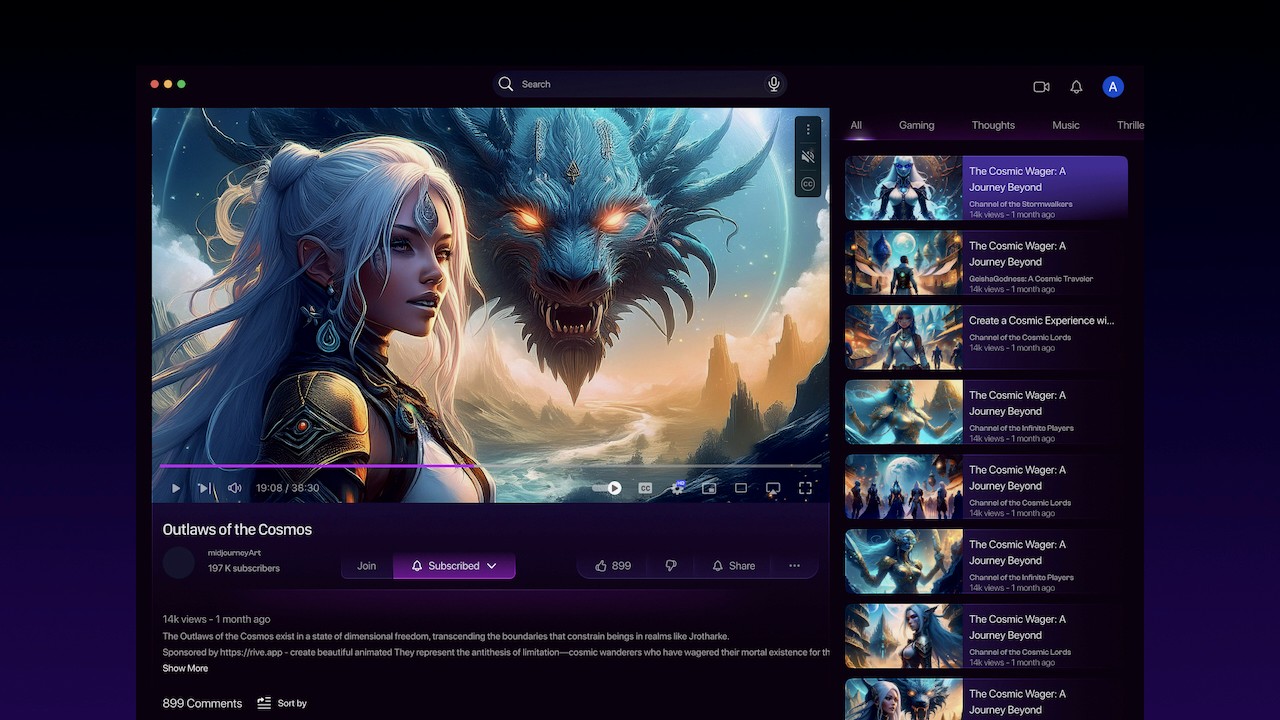
Outlaws of the Cosmos is set across three realms of existence. The Material Realms — including the world of Jrotharke — operate under physical constraints and elemental magic. The Void Between is dimensional traversal space, domain of the Stormwalkers who have sacrificed physical form for the freedom to move between realities. The Nexus is the opulent court of the Cosmic Lords, who have traded freedom of movement for the power to manipulate reality itself.
Three factions define the narrative's moral and aesthetic geometry:
Stormwalkers (Stellar Cyan, #5AC8FA) — dimensional travelers who sacrifice form for freedom. Kael Voidwalker, Thera Stormborn, Lyra Echoheart. The journey through the void is their philosophy.
Cosmic Lords (Cosmic Magenta, #BF4080) — reality architects bound by Nexus protocols, wielding influence through opulent decadence. Lady Nyx Starweaver, Lord Vex Opulent, Sovereign Lux.
Infinite Players (Energy Gold, #E9C46A) — eternal solitude in exchange for transcendence. The observers and influencers who operate without constraint. Zenith Crystalline, Cipher Infinite.
Each faction has its own color system, its own interface aesthetic, its own glow signature. When a Stormwalker card appears, the cyan pulse tells you before you read the name. That's not decorative. That's information architecture expressed through design tokens.
Five Screens, One System
The five implemented screens each showcase a different dimension of what the Oksana Creatrix platform does — and each required solving different design problems:
Screen 1: Character Content Viewer
The character profile screen needed to display complex data — faction allegiance, three-axis stat visualization (Power, Influence, Transcendence), narrative context, activity feed preview — without reading as a data table. The solution: animated stat bars with faction-specific gradient fills, asymmetric border radius (0 15px 0 15px) creating the anime panel geometry, glassmorphism cards at rgba(19, 26, 54, 0.6) with 10px backdrop blur. Information density that reads as atmosphere.
Screen 2: Updates Feed / Activity Timeline
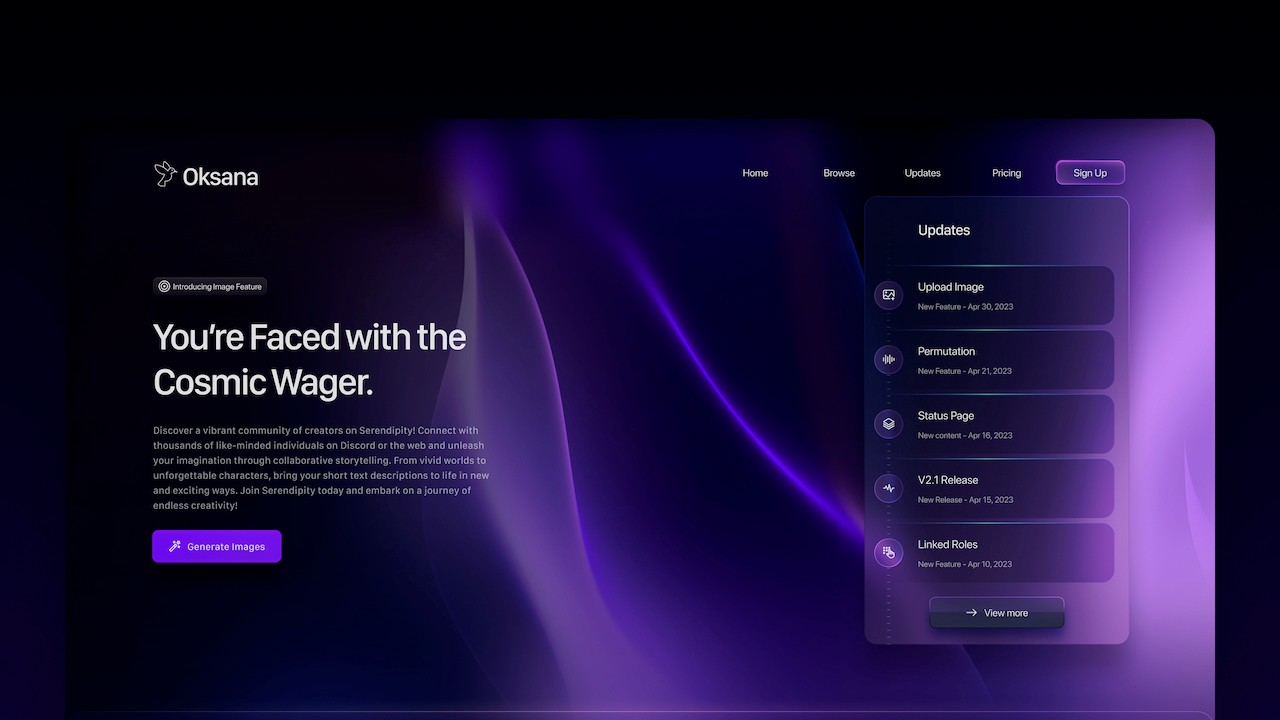
A vertical timeline with a glowing connector line — faction-colored borders on each card, timestamps, action/consequence pairs. The design challenge: make a feed feel like dimensional events across a multiverse, not a notification list. Faction-specific border glow on each update card handles that. Every item is spatially anchored to a specific cosmic entity.
Screen 3: Gallery Hero
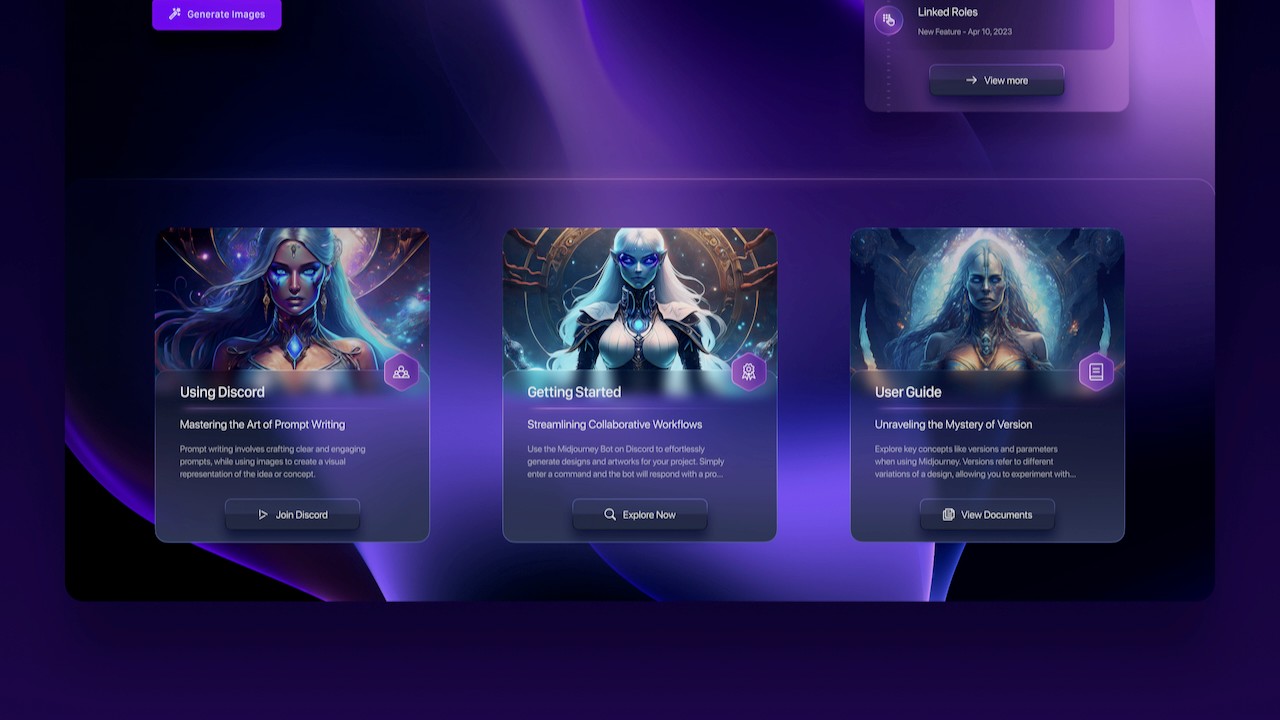
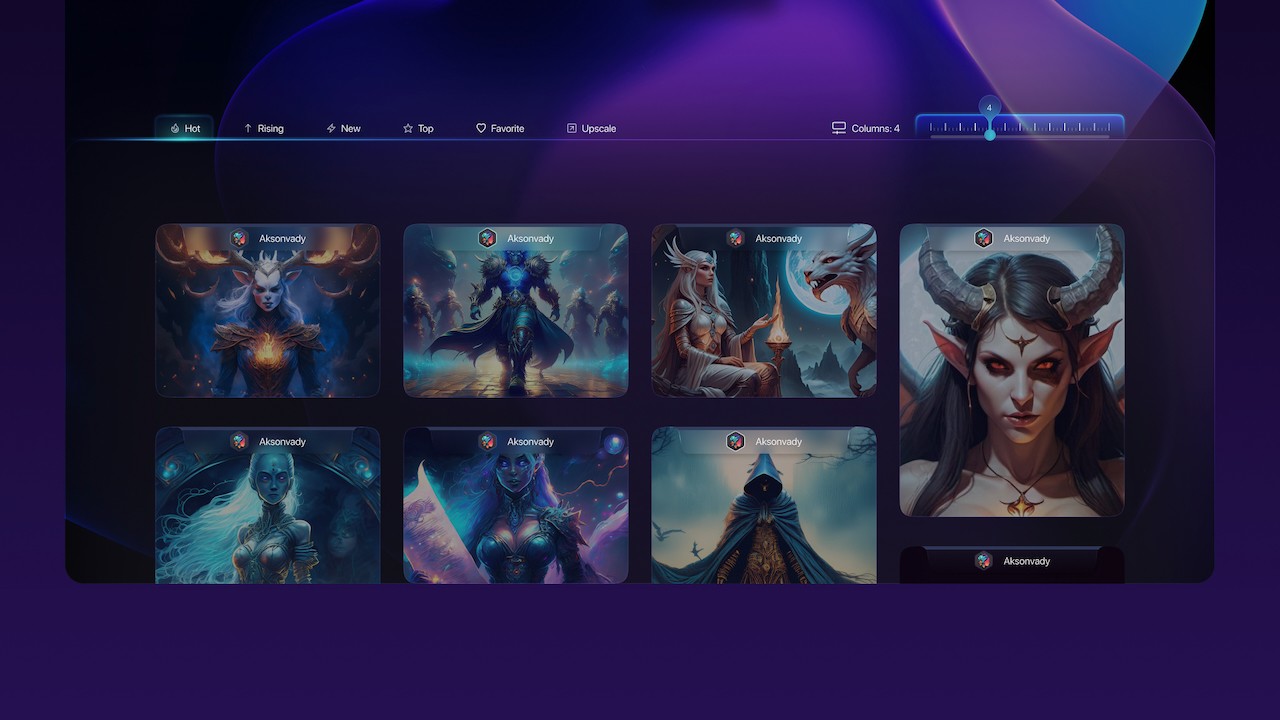
The landing screen for the narrative universe. Eight-character grid with faction-color overlays on hover, gradient hero text ("Where Artificial Intelligence Amplifies Human Creativity"), faction badges, role labels. This screen has the highest visual density of the five — it needs to communicate the full scope of the universe at a glance while remaining navigable. The grid geometry and hover-reveal pattern solve the legibility problem without sacrificing the atmospheric quality.
Screen 4: Cosmic Wager — Choice Interface
Three choice cards. Three factions. Three philosophies. "Embrace the Storm / Seek the Nexus / Transcend All." Each card carries a consequence preview badge, faction icon, glow-on-hover interaction. The Cosmic Wager is the narrative's core decision point — the interface needed to make the weight of that choice legible in the design itself. Warning indicator anchored at bottom. The asymmetry between the three options (different faction energy, different visual register) communicates that these aren't equivalent paths before the player reads a single word.
Screen 5: Analytics Dashboard
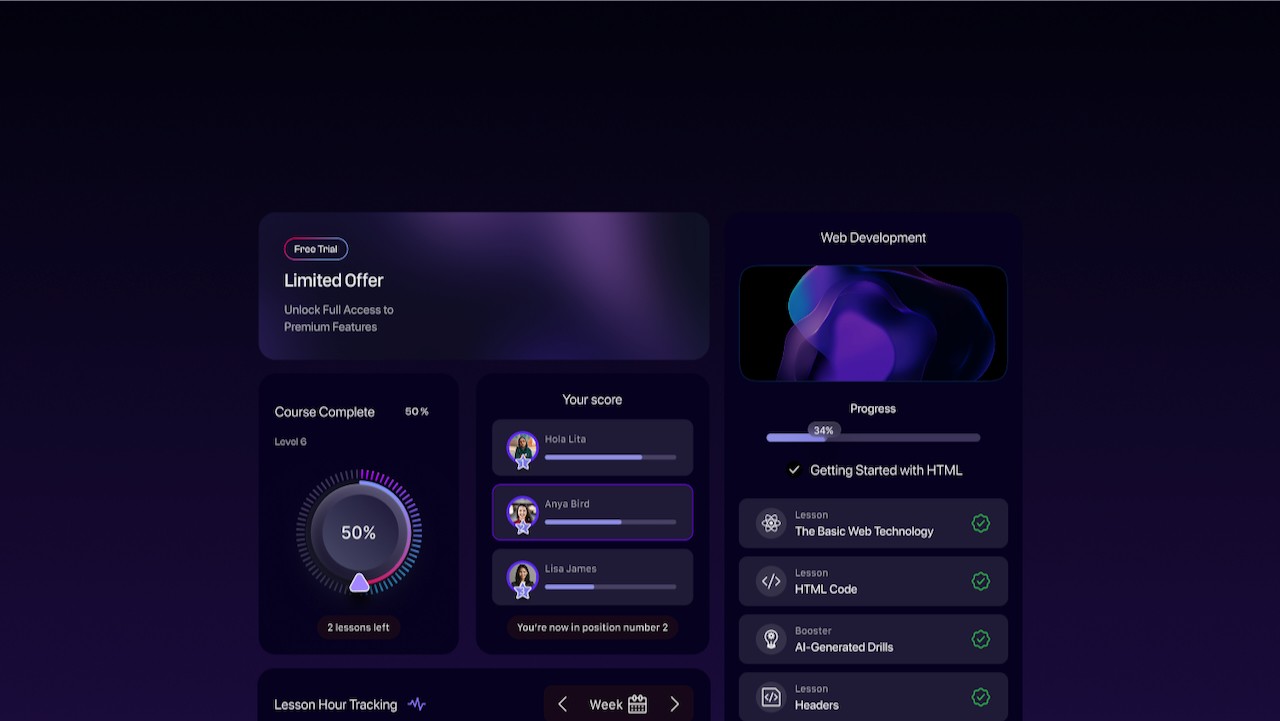
Three-column grid: profile and leaderboard on the left, quest progress and activity graph in the center, quick actions and M4 Neural Engine status on the right. Circular progress indicator at 73% completion. Faction-colored leaderboard entries. Line chart with gradient fill for activity data. This screen demonstrates that the design system scales to data-heavy contexts without losing its spatial character — the M4 Neural Engine status panel in the lower right isn't just a feature display, it's a reminder that the platform running this universe is itself optimized at the hardware level.
The Design System as Proof
The Quantum-Spatial Design System — void black (#0A0621), deep space indigo (#131A36), ultra indigo (#1E1F5C), dimensional eggplant (#331F4A) as the depth gradient; stellar cyan, cosmic magenta, energy gold as the faction signal colors — was implemented in 1,400 lines of CSS Modules. Glassmorphism effects throughout. Scanline animation at 3s linear infinite for the cyber-goth texture. Nebula pulse background at 15s ease-in-out infinite for the ambient cosmic quality. Quantum transitions at cubic-bezier(0.16, 1, 0.3, 1) — the Apple spring easing — on every interactive element.
The CSS file is itself a design document. Reading it communicates the design philosophy before you see a single rendered pixel. That's the goal for a design system implemented at this level of intentionality.
What This Demonstrates
The Cosmic Outlaws interface exists at an intersection that's genuinely rare: the ability to build a coherent fictional universe, architect the information systems that make it navigable, implement the design tokens that make it feel alive, and ship it as working production-grade code — all as a unified expression of a single creative intelligence.
Further design development and refinement is ongoing. What's already live demonstrates the core capability: a design system, a narrative universe, and a technical implementation that are inseparable from each other.
That's what it means to build with Oksana Creatrix.