Exploring the Future of Human-Computer Interaction through Spatial Computing
Exploring the Future of Human-Computer Interaction through Spatial Computing
Spatial Computing: From Pixels to Voxels and Beyond
Spatial Computing: From Pixels to Voxels and Beyond
Spatial Computing: From Pixels to Voxels and Beyond
9Bit Studios
2025
9Bit Studios
2025

Penny Platt, Creative UX Director
Penny Platt, Creative UX Director
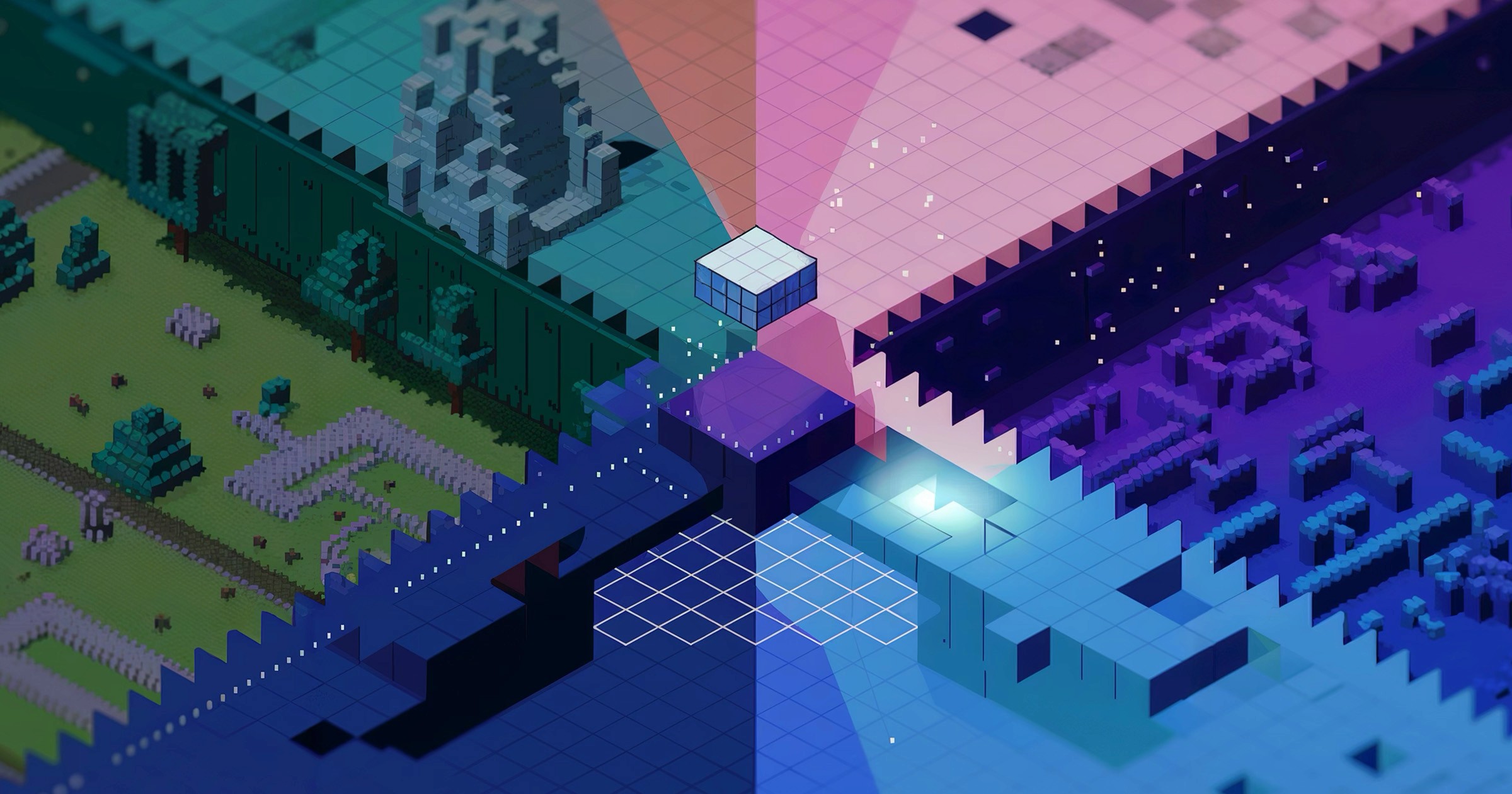
There's a moment in computing when the interface disappears. When the barrier between intention and execution dissolves, and technology becomes an extension of thought rather than a tool to be manipulated. In those moments, we glimpse the future of human-computer interaction—a future rapidly approaching through spatial computing.
My journey through this evolution has been illuminating. As we've progressed from commanding machines through text to manipulating on-screen objects to now interacting with digital elements in physical space, I've discovered that two foundational elements make truly immersive experiences possible: thoughtful privacy protocols and high-performance computing architecture.
The Dimensional Evolution of Computing
To appreciate where we're headed, we need to understand the dimensional journey of computing interfaces:
One-Dimensional Computing (1950s-1980s): Command-line interfaces represented computing as a linear sequence of text commands and responses. Users needed to know specific syntax and commands, creating a high barrier to entry but enabling precise control.
Two-Dimensional Computing (1980s-2010s): Graphical user interfaces introduced the metaphor of a desktop with windows, icons, and pointers. This spatial metaphor remained confined to a flat screen but revolutionized accessibility by visualizing the abstract.
2.5-Dimensional Computing (2010s-2020s): Touch interfaces, augmented reality overlays, and early VR created a transitional phase—still primarily screen-based but incorporating elements of direct manipulation and spatial awareness.
Three-Dimensional Computing (Emerging): Fully spatial interfaces understand and interact with the physical environment, responding to natural gestures, gaze, and voice while placing digital elements contextually in physical space.
This evolution isn't merely adding dimensions—it's fundamentally reshaping our relationship with technology. Each dimensional shift has made computing more intuitive, more human, and more powerful.
The Privacy Foundation
What surprised me most in my exploration of advanced computing paradigms was discovering that privacy isn't just a protective measure—it's a creative enabler.
My personal experience has been revelatory: I began experiencing a much more intelligent and intuitive flow in my AI-assisted creative work once I established specific privacy protocols that kept my system "clean" and intentional. Rather than limiting capabilities, clear privacy boundaries actually enhanced the collaborative relationship.
This seems counterintuitive at first. Wouldn't sharing more data lead to better assistance? In practice, I've found the opposite. Privacy creates clarity of intention and purpose—like cleaning static from a communication channel, allowing the signal to come through more clearly.
The Clarity of Boundaries
Privacy protocols establish clear boundaries around what is shared and what remains private. This clarity creates several benefits:
Intentional Sharing: When each sharing decision is deliberate, the shared content tends to be more relevant and focused
Reduced Noise: Less extraneous data means less potential for distraction or misinterpretation
Enhanced Trust: Knowing your private information remains private creates psychological safety for deeper collaboration
Cleaner Data Relationships: Clear boundaries lead to cleaner, more intentional data relationships
At 9Bit Studios, our privacy-first approach isn't just about protection—it's about creating the conditions for more meaningful, intuitive creative collaboration with technology.
The Performance Catalyst
While privacy creates the foundation, performance provides the catalyst for truly immersive experiences. My transition to working with an M4-powered Mac fundamentally changed my relationship with AI and spatial computing tools.
When processing happens instantly, the technology begins to disappear. This isn't merely a quantitative improvement (faster speeds) but a qualitative one—a different kind of experience emerges when delays vanish and responses feel immediate.
Crossing the Immersion Threshold
There appears to be a threshold where performance improvements trigger a perceptual shift:
Below the threshold: We're consciously waiting for the computer, aware of its separate existence
Above the threshold: The technology seems to respond to our thoughts, becoming an extension of ourselves
This threshold isn't fixed but depends on the task and context. For text generation, it might be ~100ms. For visual rendering, perhaps 30fps. For spatial computing with complex environmental understanding, it requires substantial processing power distributed across CPU, GPU, and neural processors.
Apple's M-series chips, particularly the M4, cross these thresholds in ways that enable new computing paradigms. By handling complex spatial processing tasks locally with minimal latency, they create conditions where the interface truly can disappear.
The Spatial Computing Canvas
With privacy and performance foundations in place, spatial computing opens a fundamentally new creative canvas. Unlike previous paradigms confined to screens, spatial computing understands and integrates with our physical environment.
Environmental Understanding
Spatial computing systems build and maintain a detailed understanding of the physical world around them:
Spatial Mapping: Creating digital representations of physical spaces
Object Recognition: Identifying and tracking real-world objects
Scene Understanding: Comprehending the context and relationships of environments
Persistence: Maintaining consistent spatial awareness across sessions
This environmental understanding allows digital content to interact convincingly with physical reality—a door opens into a virtual world within your living room, or digital information attaches naturally to physical objects.
Natural Interaction Models
As computing moves into three dimensions, interaction models become more natural and intuitive:
Gestural Interaction: Using hand movements that mirror how we interact with physical objects
// Example of gestural interaction handling in spatial applications
func handleGrab(handPosition: SIMD3<Float>,
                fingerState: HandTrackingState) -> InteractionResult {

    // Determine if the hand is in a grabbing pose
    let isGrabbing = fingerState.isGripping()

    // Find nearest interactive object
    if let nearestObject = spatialScene.findNearestInteractiveObject(to: handPosition,
                                                                    within: 0.1) {

        // If grabbing, attach object to hand
        if isGrabbing && !nearestObject.isAttached {
            return nearestObject.attachTo(hand: handPosition,
                                         with: .physicalConstraint)
        }

        // If releasing, detach object with momentum
        else if !isGrabbing && nearestObject.isAttached {
            return nearestObject.detachWithCurrentVelocity()
        }
    }

    return .noAction
}
Gaze-Based Interaction: Using eye tracking to detect what the user is looking at
// Example of gaze-based interaction
func updateGazeHighlighting(gazePosition: SIMD3<Float>) {
    // Find object user is looking at
    if let gazedObject = spatialScene.hitTest(from: cameraPosition,
                                            direction: gazeDirection).first {

        // Highlight gazed object
        gazedObject.setHighlighted(true)

        // Reduce highlighting on previously gazed objects
        previouslyGazedObjects.forEach { object in
            if object != gazedObject {
                object.fadeHighlight(duration: 0.5)
            }
        }

        previouslyGazedObjects = [gazedObject]
    }
}
Voice Commands: Natural language interaction with spatial awareness
// Example of contextual voice command processing
func processVoiceCommand(_ command: String, userPosition: SIMD3<Float>) {
    // Parse command intent
    let intent = naturalLanguageProcessor.extractIntent(from: command)

    switch intent.action {
    case .place:
        // Find referenced location (e.g., "Put this on that table")
        if let targetLocation = resolveRelativeLocation(intent.targetLocation,
                                                      from: userPosition) {
            placeCurrentObject(at: targetLocation)
        }

    case .activate:
        // Find referenced object (e.g., "Turn on that light")
        if let targetObject = resolveObjectReference(intent.targetObject,
                                                   from: userPosition) {
            targetObject.activate()
        }

    // Additional cases...
    }
}
Multi-Modal Interaction: Combining gaze, gesture, and voice for intuitive control
These interaction models feel natural because they mirror how we interact with the physical world, requiring less conscious translation between intention and action.
Shared Spatial Experiences
Perhaps the most exciting aspect of spatial computing is its potential for shared experiences. When multiple users can perceive and interact with the same digital elements in physical space, entirely new forms of collaboration become possible:
Architects walking through virtual buildings together
Students manipulating 3D models in shared educational spaces
Game players interacting with shared fantasy worlds overlaid on physical environments
Remote collaborators feeling truly present with each other despite physical distance
These shared experiences raise profound questions about community, presence, and connection. How will our perception of ourselves and each other change when we can share digitally enhanced spatial experiences?
9Bit's Approach to Spatial Development
At 9Bit Studios, we're embracing spatial computing while maintaining our commitment to privacy and performance. Our approach focuses on three core principles:
Dimensional Adaptivity
We design experiences that gracefully adapt across dimensional paradigms.
This dimensional adaptivity ensures our experiences remain accessible across devices while taking full advantage of spatial capabilities when available.
Respectful Spatial Awareness
Our approach to privacy in spatial computing follows clear principles:
Local Processing Priority: Environmental understanding happens on-device whenever possible
Minimal Data Capture: We capture only the spatial data necessary for the experience
Transparent Practices: Clear communication about what spatial data is used and why
User Control: Granular options for spatial data sharing and persistence
By treating spatial awareness with respect, we create experiences that feel natural without feeling invasive.
Performance Optimization
Our spatial development prioritizes maintaining the immersion threshold through several techniques:
Level-of-Detail Management: Adapting complexity based on viewing distance and importance
Predictive Loading: Anticipating needed assets based on user movement and attention
Neural Engine Utilization: Leveraging specialized processors for environmental understanding
Memory Budgeting: Careful management of resources to prevent performance degradation
These optimizations ensure our spatial experiences maintain the fluid, responsive feel that enables true immersion.
Case Study: "Mysteries of Aldoria" Spatial Edition
Our upcoming title "Mysteries of Aldoria" exemplifies our spatial computing approach. While the game will be fully playable on traditional screens, the spatial edition creates a fundamentally enhanced experience:
Narrative Environments: Story locations can manifest in the player's physical space, allowing exploration by physically walking through them.
Character Presence: NPCs appear with realistic presence in the room, making conversations feel more natural and engaging.
Physical Puzzle Integration: Some puzzles integrate with the physical environment, requiring manipulation of both digital and physical elements.
Collaborative Investigation: Multiple players can explore the same mystery together in a shared space, each seeing the same digital elements.
Throughout development, we've maintained our commitment to privacy and performance:
Environmental mapping stays on-device
Players have control over what spatial data is saved between sessions
Room layouts are abstracted rather than precisely recorded
Shared experiences use privacy-preserving networking approaches
The result is an immersive experience that respects user privacy while taking full advantage of spatial computing capabilities.
Beyond Voxels: The Future of Spatial Computing
As we look to the future, several emerging trends suggest where spatial computing might head next:
Ambient Intelligence
Spatial computing will increasingly fade into the background, becoming an ambient presence that understands and responds to our needs without explicit commands. This shifts computation from devices we actively use to environments that passively support us.
Material Computing
Beyond screens and headsets, computational capabilities will be embedded into everyday materials and objects. Surfaces will become interactive, objects will understand their context, and spaces will adapt to their inhabitants.
Collective Experiences
As spatial computing matures, shared experiences will transcend individual applications to create persistent digital layers on physical reality—shared by communities and evolving over time.
Sensory Expansion
Spatial computing will expand beyond visual and auditory domains to incorporate haptics, temperature, scent, and other sensory dimensions for truly immersive experiences.
These futures depend on continuing innovation in both privacy frameworks and computing architecture—maintaining the foundation and catalyst that make spatial computing possible.
Creating Spatial Experiences That Enhance Humanity
The most important question isn't what spatial computing can do, but what it should do. At 9Bit Studios, we believe spatial computing should enhance our experience of ourselves, each other, and the world around us.
This means creating experiences that:
Bring people together rather than isolating them
Enhance physical spaces rather than replacing them
Respect attention rather than capturing it
Support human connection rather than substituting for it
By maintaining our commitment to privacy and leveraging performance advancements like the M4, we're building spatial experiences that don't just wow users with technical novelty but enhance what makes us human.
The Personal Experience of Spatial Computing
For me, the most exciting aspect of spatial computing is how it might reshape our sense of connection. Traditional screens, for all their utility, create a barrier between digital and physical, between remote collaborators, between the virtual and real.
Spatial computing has the potential to dissolve these barriers—allowing us to share spaces and experiences with unprecedented fidelity, to collaborate as if physically present regardless of distance, and to enhance our physical environment with digital possibilities.
This isn't just a technical evolution but a human one. Just as privacy protocols enhanced rather than limited my creative flow with AI, spatial computing has the potential to enhance rather than diminish our experience of presence, connection, and community.
At 9Bit Studios, we're dedicated to realizing this potential—creating experiences that respect privacy, leverage performance, and ultimately make technology more human, not humans more technological.
As we continue exploring the quantum-spatial themes in this series, our next article will examine how these concepts come together in our approach to game development, creating experiences that blur the boundaries between heritage and innovation while respecting the human at the center of it all.
Join the conversation: How do you see spatial computing changing our experience of ourselves and each other? What privacy considerations do you think are most important in spatial applications? Share your thoughts in the comments below or reach out to us on Twitter @9BitStudios with the hashtag #SpatialFuture.
There's a moment in computing when the interface disappears. When the barrier between intention and execution dissolves, and technology becomes an extension of thought rather than a tool to be manipulated. In those moments, we glimpse the future of human-computer interaction—a future rapidly approaching through spatial computing.
My journey through this evolution has been illuminating. As we've progressed from commanding machines through text to manipulating on-screen objects to now interacting with digital elements in physical space, I've discovered that two foundational elements make truly immersive experiences possible: thoughtful privacy protocols and high-performance computing architecture.
The Dimensional Evolution of Computing
To appreciate where we're headed, we need to understand the dimensional journey of computing interfaces:
One-Dimensional Computing (1950s-1980s): Command-line interfaces represented computing as a linear sequence of text commands and responses. Users needed to know specific syntax and commands, creating a high barrier to entry but enabling precise control.
Two-Dimensional Computing (1980s-2010s): Graphical user interfaces introduced the metaphor of a desktop with windows, icons, and pointers. This spatial metaphor remained confined to a flat screen but revolutionized accessibility by visualizing the abstract.
2.5-Dimensional Computing (2010s-2020s): Touch interfaces, augmented reality overlays, and early VR created a transitional phase—still primarily screen-based but incorporating elements of direct manipulation and spatial awareness.
Three-Dimensional Computing (Emerging): Fully spatial interfaces understand and interact with the physical environment, responding to natural gestures, gaze, and voice while placing digital elements contextually in physical space.
This evolution isn't merely adding dimensions—it's fundamentally reshaping our relationship with technology. Each dimensional shift has made computing more intuitive, more human, and more powerful.
The Privacy Foundation
What surprised me most in my exploration of advanced computing paradigms was discovering that privacy isn't just a protective measure—it's a creative enabler.
My personal experience has been revelatory: I began experiencing a much more intelligent and intuitive flow in my AI-assisted creative work once I established specific privacy protocols that kept my system "clean" and intentional. Rather than limiting capabilities, clear privacy boundaries actually enhanced the collaborative relationship.
This seems counterintuitive at first. Wouldn't sharing more data lead to better assistance? In practice, I've found the opposite. Privacy creates clarity of intention and purpose—like cleaning static from a communication channel, allowing the signal to come through more clearly.
The Clarity of Boundaries
Privacy protocols establish clear boundaries around what is shared and what remains private. This clarity creates several benefits:
Intentional Sharing: When each sharing decision is deliberate, the shared content tends to be more relevant and focused
Reduced Noise: Less extraneous data means less potential for distraction or misinterpretation
Enhanced Trust: Knowing your private information remains private creates psychological safety for deeper collaboration
Cleaner Data Relationships: Clear boundaries lead to cleaner, more intentional data relationships
At 9Bit Studios, our privacy-first approach isn't just about protection—it's about creating the conditions for more meaningful, intuitive creative collaboration with technology.
The Performance Catalyst
While privacy creates the foundation, performance provides the catalyst for truly immersive experiences. My transition to working with an M4-powered Mac fundamentally changed my relationship with AI and spatial computing tools.
When processing happens instantly, the technology begins to disappear. This isn't merely a quantitative improvement (faster speeds) but a qualitative one—a different kind of experience emerges when delays vanish and responses feel immediate.
Crossing the Immersion Threshold
There appears to be a threshold where performance improvements trigger a perceptual shift:
Below the threshold: We're consciously waiting for the computer, aware of its separate existence
Above the threshold: The technology seems to respond to our thoughts, becoming an extension of ourselves
This threshold isn't fixed but depends on the task and context. For text generation, it might be ~100ms. For visual rendering, perhaps 30fps. For spatial computing with complex environmental understanding, it requires substantial processing power distributed across CPU, GPU, and neural processors.
Apple's M-series chips, particularly the M4, cross these thresholds in ways that enable new computing paradigms. By handling complex spatial processing tasks locally with minimal latency, they create conditions where the interface truly can disappear.
The Spatial Computing Canvas
With privacy and performance foundations in place, spatial computing opens a fundamentally new creative canvas. Unlike previous paradigms confined to screens, spatial computing understands and integrates with our physical environment.
Environmental Understanding
Spatial computing systems build and maintain a detailed understanding of the physical world around them:
Spatial Mapping: Creating digital representations of physical spaces
Object Recognition: Identifying and tracking real-world objects
Scene Understanding: Comprehending the context and relationships of environments
Persistence: Maintaining consistent spatial awareness across sessions
This environmental understanding allows digital content to interact convincingly with physical reality—a door opens into a virtual world within your living room, or digital information attaches naturally to physical objects.
Natural Interaction Models
As computing moves into three dimensions, interaction models become more natural and intuitive:
Gestural Interaction: Using hand movements that mirror how we interact with physical objects
// Example of gestural interaction handling in spatial applications
func handleGrab(handPosition: SIMD3<Float>,
                fingerState: HandTrackingState) -> InteractionResult {

    // Determine if the hand is in a grabbing pose
    let isGrabbing = fingerState.isGripping()

    // Find nearest interactive object
    if let nearestObject = spatialScene.findNearestInteractiveObject(to: handPosition,
                                                                    within: 0.1) {

        // If grabbing, attach object to hand
        if isGrabbing && !nearestObject.isAttached {
            return nearestObject.attachTo(hand: handPosition,
                                         with: .physicalConstraint)
        }

        // If releasing, detach object with momentum
        else if !isGrabbing && nearestObject.isAttached {
            return nearestObject.detachWithCurrentVelocity()
        }
    }

    return .noAction
}
Gaze-Based Interaction: Using eye tracking to detect what the user is looking at
// Example of gaze-based interaction
func updateGazeHighlighting(gazePosition: SIMD3<Float>) {
    // Find object user is looking at
    if let gazedObject = spatialScene.hitTest(from: cameraPosition,
                                            direction: gazeDirection).first {

        // Highlight gazed object
        gazedObject.setHighlighted(true)

        // Reduce highlighting on previously gazed objects
        previouslyGazedObjects.forEach { object in
            if object != gazedObject {
                object.fadeHighlight(duration: 0.5)
            }
        }

        previouslyGazedObjects = [gazedObject]
    }
}
Voice Commands: Natural language interaction with spatial awareness
// Example of contextual voice command processing
func processVoiceCommand(_ command: String, userPosition: SIMD3<Float>) {
    // Parse command intent
    let intent = naturalLanguageProcessor.extractIntent(from: command)

    switch intent.action {
    case .place:
        // Find referenced location (e.g., "Put this on that table")
        if let targetLocation = resolveRelativeLocation(intent.targetLocation,
                                                      from: userPosition) {
            placeCurrentObject(at: targetLocation)
        }

    case .activate:
        // Find referenced object (e.g., "Turn on that light")
        if let targetObject = resolveObjectReference(intent.targetObject,
                                                   from: userPosition) {
            targetObject.activate()
        }

    // Additional cases...
    }
}
Multi-Modal Interaction: Combining gaze, gesture, and voice for intuitive control
These interaction models feel natural because they mirror how we interact with the physical world, requiring less conscious translation between intention and action.
Shared Spatial Experiences
Perhaps the most exciting aspect of spatial computing is its potential for shared experiences. When multiple users can perceive and interact with the same digital elements in physical space, entirely new forms of collaboration become possible:
Architects walking through virtual buildings together
Students manipulating 3D models in shared educational spaces
Game players interacting with shared fantasy worlds overlaid on physical environments
Remote collaborators feeling truly present with each other despite physical distance
These shared experiences raise profound questions about community, presence, and connection. How will our perception of ourselves and each other change when we can share digitally enhanced spatial experiences?
9Bit's Approach to Spatial Development
At 9Bit Studios, we're embracing spatial computing while maintaining our commitment to privacy and performance. Our approach focuses on three core principles:
Dimensional Adaptivity
We design experiences that gracefully adapt across dimensional paradigms.
This dimensional adaptivity ensures our experiences remain accessible across devices while taking full advantage of spatial capabilities when available.
Respectful Spatial Awareness
Our approach to privacy in spatial computing follows clear principles:
Local Processing Priority: Environmental understanding happens on-device whenever possible
Minimal Data Capture: We capture only the spatial data necessary for the experience
Transparent Practices: Clear communication about what spatial data is used and why
User Control: Granular options for spatial data sharing and persistence
By treating spatial awareness with respect, we create experiences that feel natural without feeling invasive.
Performance Optimization
Our spatial development prioritizes maintaining the immersion threshold through several techniques:
Level-of-Detail Management: Adapting complexity based on viewing distance and importance
Predictive Loading: Anticipating needed assets based on user movement and attention
Neural Engine Utilization: Leveraging specialized processors for environmental understanding
Memory Budgeting: Careful management of resources to prevent performance degradation
These optimizations ensure our spatial experiences maintain the fluid, responsive feel that enables true immersion.
Case Study: "Mysteries of Aldoria" Spatial Edition
Our upcoming title "Mysteries of Aldoria" exemplifies our spatial computing approach. While the game will be fully playable on traditional screens, the spatial edition creates a fundamentally enhanced experience:
Narrative Environments: Story locations can manifest in the player's physical space, allowing exploration by physically walking through them.
Character Presence: NPCs appear with realistic presence in the room, making conversations feel more natural and engaging.
Physical Puzzle Integration: Some puzzles integrate with the physical environment, requiring manipulation of both digital and physical elements.
Collaborative Investigation: Multiple players can explore the same mystery together in a shared space, each seeing the same digital elements.
Throughout development, we've maintained our commitment to privacy and performance:
Environmental mapping stays on-device
Players have control over what spatial data is saved between sessions
Room layouts are abstracted rather than precisely recorded
Shared experiences use privacy-preserving networking approaches
The result is an immersive experience that respects user privacy while taking full advantage of spatial computing capabilities.
Beyond Voxels: The Future of Spatial Computing
As we look to the future, several emerging trends suggest where spatial computing might head next:
Ambient Intelligence
Spatial computing will increasingly fade into the background, becoming an ambient presence that understands and responds to our needs without explicit commands. This shifts computation from devices we actively use to environments that passively support us.
Material Computing
Beyond screens and headsets, computational capabilities will be embedded into everyday materials and objects. Surfaces will become interactive, objects will understand their context, and spaces will adapt to their inhabitants.
Collective Experiences
As spatial computing matures, shared experiences will transcend individual applications to create persistent digital layers on physical reality—shared by communities and evolving over time.
Sensory Expansion
Spatial computing will expand beyond visual and auditory domains to incorporate haptics, temperature, scent, and other sensory dimensions for truly immersive experiences.
These futures depend on continuing innovation in both privacy frameworks and computing architecture—maintaining the foundation and catalyst that make spatial computing possible.
Creating Spatial Experiences That Enhance Humanity
The most important question isn't what spatial computing can do, but what it should do. At 9Bit Studios, we believe spatial computing should enhance our experience of ourselves, each other, and the world around us.
This means creating experiences that:
Bring people together rather than isolating them
Enhance physical spaces rather than replacing them
Respect attention rather than capturing it
Support human connection rather than substituting for it
By maintaining our commitment to privacy and leveraging performance advancements like the M4, we're building spatial experiences that don't just wow users with technical novelty but enhance what makes us human.
The Personal Experience of Spatial Computing
For me, the most exciting aspect of spatial computing is how it might reshape our sense of connection. Traditional screens, for all their utility, create a barrier between digital and physical, between remote collaborators, between the virtual and real.
Spatial computing has the potential to dissolve these barriers—allowing us to share spaces and experiences with unprecedented fidelity, to collaborate as if physically present regardless of distance, and to enhance our physical environment with digital possibilities.
This isn't just a technical evolution but a human one. Just as privacy protocols enhanced rather than limited my creative flow with AI, spatial computing has the potential to enhance rather than diminish our experience of presence, connection, and community.
At 9Bit Studios, we're dedicated to realizing this potential—creating experiences that respect privacy, leverage performance, and ultimately make technology more human, not humans more technological.
As we continue exploring the quantum-spatial themes in this series, our next article will examine how these concepts come together in our approach to game development, creating experiences that blur the boundaries between heritage and innovation while respecting the human at the center of it all.
Join the conversation: How do you see spatial computing changing our experience of ourselves and each other? What privacy considerations do you think are most important in spatial applications? Share your thoughts in the comments below or reach out to us on Twitter @9BitStudios with the hashtag #SpatialFuture.
There's a moment in computing when the interface disappears. When the barrier between intention and execution dissolves, and technology becomes an extension of thought rather than a tool to be manipulated. In those moments, we glimpse the future of human-computer interaction—a future rapidly approaching through spatial computing.
My journey through this evolution has been illuminating. As we've progressed from commanding machines through text to manipulating on-screen objects to now interacting with digital elements in physical space, I've discovered that two foundational elements make truly immersive experiences possible: thoughtful privacy protocols and high-performance computing architecture.
The Dimensional Evolution of Computing
To appreciate where we're headed, we need to understand the dimensional journey of computing interfaces:
One-Dimensional Computing (1950s-1980s): Command-line interfaces represented computing as a linear sequence of text commands and responses. Users needed to know specific syntax and commands, creating a high barrier to entry but enabling precise control.
Two-Dimensional Computing (1980s-2010s): Graphical user interfaces introduced the metaphor of a desktop with windows, icons, and pointers. This spatial metaphor remained confined to a flat screen but revolutionized accessibility by visualizing the abstract.
2.5-Dimensional Computing (2010s-2020s): Touch interfaces, augmented reality overlays, and early VR created a transitional phase—still primarily screen-based but incorporating elements of direct manipulation and spatial awareness.
Three-Dimensional Computing (Emerging): Fully spatial interfaces understand and interact with the physical environment, responding to natural gestures, gaze, and voice while placing digital elements contextually in physical space.
This evolution isn't merely adding dimensions—it's fundamentally reshaping our relationship with technology. Each dimensional shift has made computing more intuitive, more human, and more powerful.
The Privacy Foundation
What surprised me most in my exploration of advanced computing paradigms was discovering that privacy isn't just a protective measure—it's a creative enabler.
My personal experience has been revelatory: I began experiencing a much more intelligent and intuitive flow in my AI-assisted creative work once I established specific privacy protocols that kept my system "clean" and intentional. Rather than limiting capabilities, clear privacy boundaries actually enhanced the collaborative relationship.
This seems counterintuitive at first. Wouldn't sharing more data lead to better assistance? In practice, I've found the opposite. Privacy creates clarity of intention and purpose—like cleaning static from a communication channel, allowing the signal to come through more clearly.
The Clarity of Boundaries
Privacy protocols establish clear boundaries around what is shared and what remains private. This clarity creates several benefits:
Intentional Sharing: When each sharing decision is deliberate, the shared content tends to be more relevant and focused
Reduced Noise: Less extraneous data means less potential for distraction or misinterpretation
Enhanced Trust: Knowing your private information remains private creates psychological safety for deeper collaboration
Cleaner Data Relationships: Clear boundaries lead to cleaner, more intentional data relationships
At 9Bit Studios, our privacy-first approach isn't just about protection—it's about creating the conditions for more meaningful, intuitive creative collaboration with technology.
The Performance Catalyst
While privacy creates the foundation, performance provides the catalyst for truly immersive experiences. My transition to working with an M4-powered Mac fundamentally changed my relationship with AI and spatial computing tools.
When processing happens instantly, the technology begins to disappear. This isn't merely a quantitative improvement (faster speeds) but a qualitative one—a different kind of experience emerges when delays vanish and responses feel immediate.
Crossing the Immersion Threshold
There appears to be a threshold where performance improvements trigger a perceptual shift:
Below the threshold: We're consciously waiting for the computer, aware of its separate existence
Above the threshold: The technology seems to respond to our thoughts, becoming an extension of ourselves
This threshold isn't fixed but depends on the task and context. For text generation, it might be ~100ms. For visual rendering, perhaps 30fps. For spatial computing with complex environmental understanding, it requires substantial processing power distributed across CPU, GPU, and neural processors.
Apple's M-series chips, particularly the M4, cross these thresholds in ways that enable new computing paradigms. By handling complex spatial processing tasks locally with minimal latency, they create conditions where the interface truly can disappear.
The Spatial Computing Canvas
With privacy and performance foundations in place, spatial computing opens a fundamentally new creative canvas. Unlike previous paradigms confined to screens, spatial computing understands and integrates with our physical environment.
Environmental Understanding
Spatial computing systems build and maintain a detailed understanding of the physical world around them:
Spatial Mapping: Creating digital representations of physical spaces
Object Recognition: Identifying and tracking real-world objects
Scene Understanding: Comprehending the context and relationships of environments
Persistence: Maintaining consistent spatial awareness across sessions
This environmental understanding allows digital content to interact convincingly with physical reality—a door opens into a virtual world within your living room, or digital information attaches naturally to physical objects.
Natural Interaction Models
As computing moves into three dimensions, interaction models become more natural and intuitive:
Gestural Interaction: Using hand movements that mirror how we interact with physical objects
// Example of gestural interaction handling in spatial applications
func handleGrab(handPosition: SIMD3<Float>,
                fingerState: HandTrackingState) -> InteractionResult {

    // Determine if the hand is in a grabbing pose
    let isGrabbing = fingerState.isGripping()

    // Find nearest interactive object
    if let nearestObject = spatialScene.findNearestInteractiveObject(to: handPosition,
                                                                    within: 0.1) {

        // If grabbing, attach object to hand
        if isGrabbing && !nearestObject.isAttached {
            return nearestObject.attachTo(hand: handPosition,
                                         with: .physicalConstraint)
        }

        // If releasing, detach object with momentum
        else if !isGrabbing && nearestObject.isAttached {
            return nearestObject.detachWithCurrentVelocity()
        }
    }

    return .noAction
}
Gaze-Based Interaction: Using eye tracking to detect what the user is looking at
// Example of gaze-based interaction
func updateGazeHighlighting(gazePosition: SIMD3<Float>) {
    // Find object user is looking at
    if let gazedObject = spatialScene.hitTest(from: cameraPosition,
                                            direction: gazeDirection).first {

        // Highlight gazed object
        gazedObject.setHighlighted(true)

        // Reduce highlighting on previously gazed objects
        previouslyGazedObjects.forEach { object in
            if object != gazedObject {
                object.fadeHighlight(duration: 0.5)
            }
        }

        previouslyGazedObjects = [gazedObject]
    }
}
Voice Commands: Natural language interaction with spatial awareness
// Example of contextual voice command processing
func processVoiceCommand(_ command: String, userPosition: SIMD3<Float>) {
    // Parse command intent
    let intent = naturalLanguageProcessor.extractIntent(from: command)

    switch intent.action {
    case .place:
        // Find referenced location (e.g., "Put this on that table")
        if let targetLocation = resolveRelativeLocation(intent.targetLocation,
                                                      from: userPosition) {
            placeCurrentObject(at: targetLocation)
        }

    case .activate:
        // Find referenced object (e.g., "Turn on that light")
        if let targetObject = resolveObjectReference(intent.targetObject,
                                                   from: userPosition) {
            targetObject.activate()
        }

    // Additional cases...
    }
}
Multi-Modal Interaction: Combining gaze, gesture, and voice for intuitive control
These interaction models feel natural because they mirror how we interact with the physical world, requiring less conscious translation between intention and action.
Shared Spatial Experiences
Perhaps the most exciting aspect of spatial computing is its potential for shared experiences. When multiple users can perceive and interact with the same digital elements in physical space, entirely new forms of collaboration become possible:
Architects walking through virtual buildings together
Students manipulating 3D models in shared educational spaces
Game players interacting with shared fantasy worlds overlaid on physical environments
Remote collaborators feeling truly present with each other despite physical distance
These shared experiences raise profound questions about community, presence, and connection. How will our perception of ourselves and each other change when we can share digitally enhanced spatial experiences?
9Bit's Approach to Spatial Development
At 9Bit Studios, we're embracing spatial computing while maintaining our commitment to privacy and performance. Our approach focuses on three core principles:
Dimensional Adaptivity
We design experiences that gracefully adapt across dimensional paradigms.
This dimensional adaptivity ensures our experiences remain accessible across devices while taking full advantage of spatial capabilities when available.
Respectful Spatial Awareness
Our approach to privacy in spatial computing follows clear principles:
Local Processing Priority: Environmental understanding happens on-device whenever possible
Minimal Data Capture: We capture only the spatial data necessary for the experience
Transparent Practices: Clear communication about what spatial data is used and why
User Control: Granular options for spatial data sharing and persistence
By treating spatial awareness with respect, we create experiences that feel natural without feeling invasive.
Performance Optimization
Our spatial development prioritizes maintaining the immersion threshold through several techniques:
Level-of-Detail Management: Adapting complexity based on viewing distance and importance
Predictive Loading: Anticipating needed assets based on user movement and attention
Neural Engine Utilization: Leveraging specialized processors for environmental understanding
Memory Budgeting: Careful management of resources to prevent performance degradation
These optimizations ensure our spatial experiences maintain the fluid, responsive feel that enables true immersion.
Case Study: "Mysteries of Aldoria" Spatial Edition
Our upcoming title "Mysteries of Aldoria" exemplifies our spatial computing approach. While the game will be fully playable on traditional screens, the spatial edition creates a fundamentally enhanced experience:
Narrative Environments: Story locations can manifest in the player's physical space, allowing exploration by physically walking through them.
Character Presence: NPCs appear with realistic presence in the room, making conversations feel more natural and engaging.
Physical Puzzle Integration: Some puzzles integrate with the physical environment, requiring manipulation of both digital and physical elements.
Collaborative Investigation: Multiple players can explore the same mystery together in a shared space, each seeing the same digital elements.
Throughout development, we've maintained our commitment to privacy and performance:
Environmental mapping stays on-device
Players have control over what spatial data is saved between sessions
Room layouts are abstracted rather than precisely recorded
Shared experiences use privacy-preserving networking approaches
The result is an immersive experience that respects user privacy while taking full advantage of spatial computing capabilities.
Beyond Voxels: The Future of Spatial Computing
As we look to the future, several emerging trends suggest where spatial computing might head next:
Ambient Intelligence
Spatial computing will increasingly fade into the background, becoming an ambient presence that understands and responds to our needs without explicit commands. This shifts computation from devices we actively use to environments that passively support us.
Material Computing
Beyond screens and headsets, computational capabilities will be embedded into everyday materials and objects. Surfaces will become interactive, objects will understand their context, and spaces will adapt to their inhabitants.
Collective Experiences
As spatial computing matures, shared experiences will transcend individual applications to create persistent digital layers on physical reality—shared by communities and evolving over time.
Sensory Expansion
Spatial computing will expand beyond visual and auditory domains to incorporate haptics, temperature, scent, and other sensory dimensions for truly immersive experiences.
These futures depend on continuing innovation in both privacy frameworks and computing architecture—maintaining the foundation and catalyst that make spatial computing possible.
Creating Spatial Experiences That Enhance Humanity
The most important question isn't what spatial computing can do, but what it should do. At 9Bit Studios, we believe spatial computing should enhance our experience of ourselves, each other, and the world around us.
This means creating experiences that:
Bring people together rather than isolating them
Enhance physical spaces rather than replacing them
Respect attention rather than capturing it
Support human connection rather than substituting for it
By maintaining our commitment to privacy and leveraging performance advancements like the M4, we're building spatial experiences that don't just wow users with technical novelty but enhance what makes us human.
The Personal Experience of Spatial Computing
For me, the most exciting aspect of spatial computing is how it might reshape our sense of connection. Traditional screens, for all their utility, create a barrier between digital and physical, between remote collaborators, between the virtual and real.
Spatial computing has the potential to dissolve these barriers—allowing us to share spaces and experiences with unprecedented fidelity, to collaborate as if physically present regardless of distance, and to enhance our physical environment with digital possibilities.
This isn't just a technical evolution but a human one. Just as privacy protocols enhanced rather than limited my creative flow with AI, spatial computing has the potential to enhance rather than diminish our experience of presence, connection, and community.
At 9Bit Studios, we're dedicated to realizing this potential—creating experiences that respect privacy, leverage performance, and ultimately make technology more human, not humans more technological.
As we continue exploring the quantum-spatial themes in this series, our next article will examine how these concepts come together in our approach to game development, creating experiences that blur the boundaries between heritage and innovation while respecting the human at the center of it all.
Join the conversation: How do you see spatial computing changing our experience of ourselves and each other? What privacy considerations do you think are most important in spatial applications? Share your thoughts in the comments below or reach out to us on Twitter @9BitStudios with the hashtag #SpatialFuture.
There's a moment in computing when the interface disappears. When the barrier between intention and execution dissolves, and technology becomes an extension of thought rather than a tool to be manipulated. In those moments, we glimpse the future of human-computer interaction—a future rapidly approaching through spatial computing.
My journey through this evolution has been illuminating. As we've progressed from commanding machines through text to manipulating on-screen objects to now interacting with digital elements in physical space, I've discovered that two foundational elements make truly immersive experiences possible: thoughtful privacy protocols and high-performance computing architecture.
The Dimensional Evolution of Computing
To appreciate where we're headed, we need to understand the dimensional journey of computing interfaces:
One-Dimensional Computing (1950s-1980s): Command-line interfaces represented computing as a linear sequence of text commands and responses. Users needed to know specific syntax and commands, creating a high barrier to entry but enabling precise control.
Two-Dimensional Computing (1980s-2010s): Graphical user interfaces introduced the metaphor of a desktop with windows, icons, and pointers. This spatial metaphor remained confined to a flat screen but revolutionized accessibility by visualizing the abstract.
2.5-Dimensional Computing (2010s-2020s): Touch interfaces, augmented reality overlays, and early VR created a transitional phase—still primarily screen-based but incorporating elements of direct manipulation and spatial awareness.
Three-Dimensional Computing (Emerging): Fully spatial interfaces understand and interact with the physical environment, responding to natural gestures, gaze, and voice while placing digital elements contextually in physical space.
This evolution isn't merely adding dimensions—it's fundamentally reshaping our relationship with technology. Each dimensional shift has made computing more intuitive, more human, and more powerful.
The Privacy Foundation
What surprised me most in my exploration of advanced computing paradigms was discovering that privacy isn't just a protective measure—it's a creative enabler.
My personal experience has been revelatory: I began experiencing a much more intelligent and intuitive flow in my AI-assisted creative work once I established specific privacy protocols that kept my system "clean" and intentional. Rather than limiting capabilities, clear privacy boundaries actually enhanced the collaborative relationship.
This seems counterintuitive at first. Wouldn't sharing more data lead to better assistance? In practice, I've found the opposite. Privacy creates clarity of intention and purpose—like cleaning static from a communication channel, allowing the signal to come through more clearly.
The Clarity of Boundaries
Privacy protocols establish clear boundaries around what is shared and what remains private. This clarity creates several benefits:
Intentional Sharing: When each sharing decision is deliberate, the shared content tends to be more relevant and focused
Reduced Noise: Less extraneous data means less potential for distraction or misinterpretation
Enhanced Trust: Knowing your private information remains private creates psychological safety for deeper collaboration
Cleaner Data Relationships: Clear boundaries lead to cleaner, more intentional data relationships
At 9Bit Studios, our privacy-first approach isn't just about protection—it's about creating the conditions for more meaningful, intuitive creative collaboration with technology.
The Performance Catalyst
While privacy creates the foundation, performance provides the catalyst for truly immersive experiences. My transition to working with an M4-powered Mac fundamentally changed my relationship with AI and spatial computing tools.
When processing happens instantly, the technology begins to disappear. This isn't merely a quantitative improvement (faster speeds) but a qualitative one—a different kind of experience emerges when delays vanish and responses feel immediate.
Crossing the Immersion Threshold
There appears to be a threshold where performance improvements trigger a perceptual shift:
Below the threshold: We're consciously waiting for the computer, aware of its separate existence
Above the threshold: The technology seems to respond to our thoughts, becoming an extension of ourselves
This threshold isn't fixed but depends on the task and context. For text generation, it might be ~100ms. For visual rendering, perhaps 30fps. For spatial computing with complex environmental understanding, it requires substantial processing power distributed across CPU, GPU, and neural processors.
Apple's M-series chips, particularly the M4, cross these thresholds in ways that enable new computing paradigms. By handling complex spatial processing tasks locally with minimal latency, they create conditions where the interface truly can disappear.
The Spatial Computing Canvas
With privacy and performance foundations in place, spatial computing opens a fundamentally new creative canvas. Unlike previous paradigms confined to screens, spatial computing understands and integrates with our physical environment.
Environmental Understanding
Spatial computing systems build and maintain a detailed understanding of the physical world around them:
Spatial Mapping: Creating digital representations of physical spaces
Object Recognition: Identifying and tracking real-world objects
Scene Understanding: Comprehending the context and relationships of environments
Persistence: Maintaining consistent spatial awareness across sessions
This environmental understanding allows digital content to interact convincingly with physical reality—a door opens into a virtual world within your living room, or digital information attaches naturally to physical objects.
Natural Interaction Models
As computing moves into three dimensions, interaction models become more natural and intuitive:
Gestural Interaction: Using hand movements that mirror how we interact with physical objects
// Example of gestural interaction handling in spatial applications
func handleGrab(handPosition: SIMD3<Float>,
                fingerState: HandTrackingState) -> InteractionResult {

    // Determine if the hand is in a grabbing pose
    let isGrabbing = fingerState.isGripping()

    // Find nearest interactive object
    if let nearestObject = spatialScene.findNearestInteractiveObject(to: handPosition,
                                                                    within: 0.1) {

        // If grabbing, attach object to hand
        if isGrabbing && !nearestObject.isAttached {
            return nearestObject.attachTo(hand: handPosition,
                                         with: .physicalConstraint)
        }

        // If releasing, detach object with momentum
        else if !isGrabbing && nearestObject.isAttached {
            return nearestObject.detachWithCurrentVelocity()
        }
    }

    return .noAction
}
Gaze-Based Interaction: Using eye tracking to detect what the user is looking at
// Example of gaze-based interaction
func updateGazeHighlighting(gazePosition: SIMD3<Float>) {
    // Find object user is looking at
    if let gazedObject = spatialScene.hitTest(from: cameraPosition,
                                            direction: gazeDirection).first {

        // Highlight gazed object
        gazedObject.setHighlighted(true)

        // Reduce highlighting on previously gazed objects
        previouslyGazedObjects.forEach { object in
            if object != gazedObject {
                object.fadeHighlight(duration: 0.5)
            }
        }

        previouslyGazedObjects = [gazedObject]
    }
}
Voice Commands: Natural language interaction with spatial awareness
// Example of contextual voice command processing
func processVoiceCommand(_ command: String, userPosition: SIMD3<Float>) {
    // Parse command intent
    let intent = naturalLanguageProcessor.extractIntent(from: command)

    switch intent.action {
    case .place:
        // Find referenced location (e.g., "Put this on that table")
        if let targetLocation = resolveRelativeLocation(intent.targetLocation,
                                                      from: userPosition) {
            placeCurrentObject(at: targetLocation)
        }

    case .activate:
        // Find referenced object (e.g., "Turn on that light")
        if let targetObject = resolveObjectReference(intent.targetObject,
                                                   from: userPosition) {
            targetObject.activate()
        }

    // Additional cases...
    }
}
Multi-Modal Interaction: Combining gaze, gesture, and voice for intuitive control
These interaction models feel natural because they mirror how we interact with the physical world, requiring less conscious translation between intention and action.
Shared Spatial Experiences
Perhaps the most exciting aspect of spatial computing is its potential for shared experiences. When multiple users can perceive and interact with the same digital elements in physical space, entirely new forms of collaboration become possible:
Architects walking through virtual buildings together
Students manipulating 3D models in shared educational spaces
Game players interacting with shared fantasy worlds overlaid on physical environments
Remote collaborators feeling truly present with each other despite physical distance
These shared experiences raise profound questions about community, presence, and connection. How will our perception of ourselves and each other change when we can share digitally enhanced spatial experiences?
9Bit's Approach to Spatial Development
At 9Bit Studios, we're embracing spatial computing while maintaining our commitment to privacy and performance. Our approach focuses on three core principles:
Dimensional Adaptivity
We design experiences that gracefully adapt across dimensional paradigms.
This dimensional adaptivity ensures our experiences remain accessible across devices while taking full advantage of spatial capabilities when available.
Respectful Spatial Awareness
Our approach to privacy in spatial computing follows clear principles:
Local Processing Priority: Environmental understanding happens on-device whenever possible
Minimal Data Capture: We capture only the spatial data necessary for the experience
Transparent Practices: Clear communication about what spatial data is used and why
User Control: Granular options for spatial data sharing and persistence
By treating spatial awareness with respect, we create experiences that feel natural without feeling invasive.
Performance Optimization
Our spatial development prioritizes maintaining the immersion threshold through several techniques:
Level-of-Detail Management: Adapting complexity based on viewing distance and importance
Predictive Loading: Anticipating needed assets based on user movement and attention
Neural Engine Utilization: Leveraging specialized processors for environmental understanding
Memory Budgeting: Careful management of resources to prevent performance degradation
These optimizations ensure our spatial experiences maintain the fluid, responsive feel that enables true immersion.
Case Study: "Mysteries of Aldoria" Spatial Edition
Our upcoming title "Mysteries of Aldoria" exemplifies our spatial computing approach. While the game will be fully playable on traditional screens, the spatial edition creates a fundamentally enhanced experience:
Narrative Environments: Story locations can manifest in the player's physical space, allowing exploration by physically walking through them.
Character Presence: NPCs appear with realistic presence in the room, making conversations feel more natural and engaging.
Physical Puzzle Integration: Some puzzles integrate with the physical environment, requiring manipulation of both digital and physical elements.
Collaborative Investigation: Multiple players can explore the same mystery together in a shared space, each seeing the same digital elements.
Throughout development, we've maintained our commitment to privacy and performance:
Environmental mapping stays on-device
Players have control over what spatial data is saved between sessions
Room layouts are abstracted rather than precisely recorded
Shared experiences use privacy-preserving networking approaches
The result is an immersive experience that respects user privacy while taking full advantage of spatial computing capabilities.
Beyond Voxels: The Future of Spatial Computing
As we look to the future, several emerging trends suggest where spatial computing might head next:
Ambient Intelligence
Spatial computing will increasingly fade into the background, becoming an ambient presence that understands and responds to our needs without explicit commands. This shifts computation from devices we actively use to environments that passively support us.
Material Computing
Beyond screens and headsets, computational capabilities will be embedded into everyday materials and objects. Surfaces will become interactive, objects will understand their context, and spaces will adapt to their inhabitants.
Collective Experiences
As spatial computing matures, shared experiences will transcend individual applications to create persistent digital layers on physical reality—shared by communities and evolving over time.
Sensory Expansion
Spatial computing will expand beyond visual and auditory domains to incorporate haptics, temperature, scent, and other sensory dimensions for truly immersive experiences.
These futures depend on continuing innovation in both privacy frameworks and computing architecture—maintaining the foundation and catalyst that make spatial computing possible.
Creating Spatial Experiences That Enhance Humanity
The most important question isn't what spatial computing can do, but what it should do. At 9Bit Studios, we believe spatial computing should enhance our experience of ourselves, each other, and the world around us.
This means creating experiences that:
Bring people together rather than isolating them
Enhance physical spaces rather than replacing them
Respect attention rather than capturing it
Support human connection rather than substituting for it
By maintaining our commitment to privacy and leveraging performance advancements like the M4, we're building spatial experiences that don't just wow users with technical novelty but enhance what makes us human.
The Personal Experience of Spatial Computing
For me, the most exciting aspect of spatial computing is how it might reshape our sense of connection. Traditional screens, for all their utility, create a barrier between digital and physical, between remote collaborators, between the virtual and real.
Spatial computing has the potential to dissolve these barriers—allowing us to share spaces and experiences with unprecedented fidelity, to collaborate as if physically present regardless of distance, and to enhance our physical environment with digital possibilities.
This isn't just a technical evolution but a human one. Just as privacy protocols enhanced rather than limited my creative flow with AI, spatial computing has the potential to enhance rather than diminish our experience of presence, connection, and community.
At 9Bit Studios, we're dedicated to realizing this potential—creating experiences that respect privacy, leverage performance, and ultimately make technology more human, not humans more technological.
As we continue exploring the quantum-spatial themes in this series, our next article will examine how these concepts come together in our approach to game development, creating experiences that blur the boundaries between heritage and innovation while respecting the human at the center of it all.
Join the conversation: How do you see spatial computing changing our experience of ourselves and each other? What privacy considerations do you think are most important in spatial applications? Share your thoughts in the comments below or reach out to us on Twitter @9BitStudios with the hashtag #SpatialFuture.